




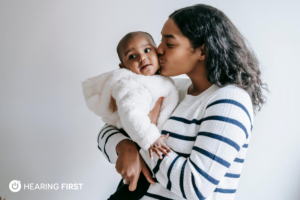
Once your baby exits the newborn stage, you’ll notice how curious and playful they’re becoming! Between 4 and 6 months, your little one is ready to play, which is their way of exploring and learning.
Around this time, many parents start wondering, “What’s the best toy for my 4–6-month-old to play with?” Nothing you can buy comes close to the developmental power of your voice during everyday interactions with your baby. As a parent, you’re the key to developing your child’s listening and spoken language skills.
Hearing Highlights: Months 4-6
- Hearing your voice when you talk, read, sing, and play together is more powerful than any toy for building your baby’s language.
- At 4–6 months, babies begin connecting the words they hear to people, objects, and activities around them.
- Back-and-forth “conversations” build neural connections for language, memory, and attention.
- Everyday play is the best way to build listening and talking skills at this age.
- If your baby isn’t responding to sound or voices by 6 months, talk to your pediatrician.
What’s Happening in the Brain?
Between 4 and 6 months, your baby is discovering communication and learning that sounds matter! At this age, babies begin tuning in to the sounds of their native language. They’re starting to connect what they hear with the people, objects, and activities around them.
Every time you talk to your baby, you’re giving their auditory system exactly what it needs: real speech, shaped by emotion, rhythm, and relationship. Each exchange builds neural connections in the brain that support not only language and listening, but also attention, memory, and literacy.
Hearing and Talking Milestones for 4- to 6-Month-Olds
At this age, your baby becomes more of a purposeful listener during your daily routines and conversations together. You may notice your baby starting to:
- Turn their eyes and head toward your voice and other sounds.
- React to different vocal tones, like smiling at a dramatic, funny voice or calming when you sing.
- Enjoy hearing their own sounds, as they play with gurgling, laughing, babbling, blowing raspberries, and making squealing sounds.
- Babble with varied sounds, especially consonant-vowel combinations like “ba” and “da”.
- Play with their voice in response to yours.
If you’re not noticing these responses by 6 months, mention it at your next pediatrician appointment. When it comes to hearing concerns, it’s important not to wait. With early identification and intervention, children with hearing loss have the opportunity to listen and talk just like kids with typical hearing.
Supporting Hearing and Talking Milestones Through Play
Play is how babies learn! They don’t need any specific toys, they just need YOU! Here are some meaningful ways to boost your interactions as you play together to help them learn to listen and talk.
Serve and Return
When you have a back-and-forth exchange with your baby, or a “conversation,” this is known as serve and return. It’s one of the most important interactions in early childhood development.
When they coo or babble, say something in response. When you’re talking to them, try to pause, wait, lean in, and look expectantly. This signals to them that it’s their turn to respond. Before you know it, you and your baby are talking together before they’ve even said their first words!
Ear Contact Before Eye Contact
One of the most effective things you can do at this stage to build listening skills is prioritizing what’s called audition first. This is when you help your baby hear something before they see it.
Before you pop up from behind a blanket during peek-a-boo, narrate first: “Where’s Mama? Where did she go?” They hear your voice, anticipate what’s coming, and then see your smiling face!
You can also make sounds before showing them a toy. “Quack quack! What’s that I hear? Quack quack! Oh, it’s your rubber duck for bathtime. Here is your duck!”
Soon, they’ll start anticipating what’s coming and look or reach for it before they even see it! That sequence of hearing before seeing gives their brain a moment to connect meaning to the sound they’re hearing.
Play-by-Play
Think of yourself as a sportscaster giving a play-by-play of the game, except the game is your baby’s day. Talk about everything you’re doing and describe what your baby is doing too! This approach puts words to whatever is happening in real time, which helps your baby connect language and meaning to their actions.
- “Now we’re shaking the rattle. Shake, shake, shake!”
- “You’re reaching for the bunny. You’ve almost got it!”
- “Oh you are so happy to see Grandma! Hi, Grandma!”
- “Oh, baby. You are so upset. You do not like having your diaper changed.”
When you narrate your baby’s experience, you’re building the vocabulary and listening attention that will eventually become their own words.
Follow Their Lead
Watch what your baby is interested in and join them there. If they’re patting a toy, pat it too and talk about it. If they’re fixated on a particular sound or texture, lean in and tell them all about what they’re exploring.
Remember that toys will come and go. But your voice is irreplaceable. At this stage, showing up and talking is the most important thing you can do for their development. Bonus? No batteries required.
Hearing First helps families who have a child with hearing loss so they can learn to listen, talk, read, and thrive.