



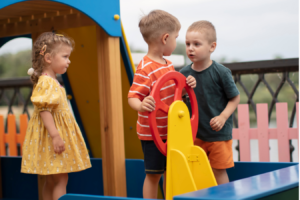
One minute your 40-month-old is happily building a tower with a friend. The next, they’re grabbing a toy, insisting everyone play by their rules, or giving someone a shove. These moments can leave parents wondering, Is this normal? Should I be worried?
The good news is that for many preschoolers, these behaviors are a typical part of learning how to interact with others. At 40 months, children are still developing impulse control, emotional regulation, and social skills. While hitting, pushing, and bossiness shouldn’t be ignored, they’re often signs that your child needs guidance, not punishment.
Highlights
- Hitting, pushing, and bossiness are common at 40 months as children develop self-control and social skills.
- Responding calmly and consistently helps children learn more appropriate ways to express their feelings and needs.
- Practicing sharing, taking turns, and problem-solving during everyday play builds lifelong social skills.
- If aggressive behaviors are frequent, severe, or don’t improve over time, it’s a good idea to talk with your child’s pediatrician.
Why Does This Happen?
Your child’s brain is growing rapidly, but the areas responsible for self-control and flexible thinking are still developing. When a child feels frustrated, excited, or disappointed, it’s often easier to push than to explain how they’re feeling.
Bossiness is also common at this age. Preschoolers love imaginative play, and many enjoy deciding what everyone should do. While this can lead to disagreements, it also shows that your child is developing creativity, confidence, and leadership skills. The challenge is learning that friends have ideas and preferences, too.
How Should You Respond?
When aggressive behavior happens, start by making sure everyone is safe. Then, calmly set a clear limit without shaming your child.
You might say, «I won’t let you hit. If you want the truck, you can ask for a turn.»
Keep your response brief and consistent. Young children learn through repetition, and every conflict is an opportunity to practice a better way of handling the situation. Over time, your child will begin replacing physical actions with words and problem-solving skills.
Build Social Skills Through Everyday Play
Children don’t learn cooperation only when conflicts happen, but also during everyday interactions.
Try creating opportunities to practice skills like:
- Taking turns during games.
- Sharing toys or materials during play.
- Talking about emotions while reading books together.
You can also model respectful communication by saying things like, «I’d like a turn when you’re finished,» or «Let’s find a solution that works for both of us.» Children learn a great deal by watching the adults around them.
Notice What Goes Well
When your child uses kind words, waits for a turn, or solves a problem without pushing, let them know you noticed.
Specific praise such as, «You asked instead of grabbing,» or «You let your friend choose the game,» helps children understand exactly which behaviors to repeat. Positive attention often encourages more cooperation than focusing only on mistakes.
Remember that learning social skills takes years. Your child won’t get it right every time, and that’s okay. Progress comes through many small moments of practice.
When Might It Be Something More?
Most children gradually outgrow frequent hitting and pushing as their language, emotional regulation, and problem-solving skills improve.
However, consider talking with your child’s pediatrician if the behavior becomes more intense over time, causes serious injuries, occurs in many different settings, or doesn’t improve despite consistent guidance. It’s also worth discussing if aggression is accompanied by concerns about communication, social interaction, or other areas of development.
Seeking advice doesn’t mean something is wrong, it simply helps ensure your child receives the support they need if additional strategies would be helpful.
Every disagreement, every shared toy, and every repaired friendship is part of learning. With your calm guidance, clear boundaries, and plenty of opportunities to practice, your preschooler is developing the skills they’ll use to build healthy relationships for years to come.
Back